
The Kidnapping Epidemic
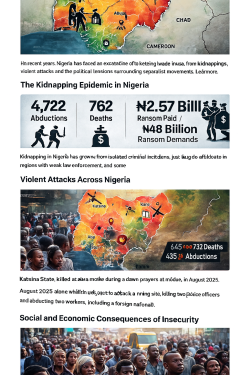
In recent years, kidnapping in Nigeria has escalated into a deeply entrenched problem, not just a crime, but a business. According to a recent report by SBM Intelligence, between July 2024 and June 2025, 4,722 people were abducted across the country.
The human toll is severe: 762 people are reported to have been killed during this period, even though ransom was paid in many cases. The total ransom demands during that window reportedly reached ₦48 billion, though only about ₦2.57 billion was actually paid.
This isn’t a random crime wave. Kidnapping in Nigeria has evolved into a “lucrative criminal enterprise,” driven by poverty, weak law enforcement, and economic instability. Bandit groups, particularly in the North, have entrenched hideouts, as many as 270 “enclaves” of terrorists and bandits were recently reported.
The scale is almost unfathomable: in one recent national crime‑survey period, Nigerians reportedly paid ₦2.2 trillion in ransom. This is not just about loss of life, it’s an economic hemorrhage, and it feeds back into the insecurity cycle.
Attacks and Violence
Kidnappings are only part of the insecurity picture. Violent attacks by armed groups continue across many parts of the country.
In Katsina State, for example, gunmen attacked a mosque during dawn prayers in August 2025, killing at least 17 worshippers.
In Kwara State, militants reportedly attacked a marble mining site in June, killing two police officers and abducting at least two workers (including a foreign national).
According to a security firm’s report, in August 2025 alone there were 545 “security incidents,” resulting in 732 deaths and 435 abductions.
These figures highlight a grim reality: despite some tactical successes by security forces, insecurity remains deeply rooted and deadly.
Social Consequences
The widespread violence is fracturing trust in institutions. Many Nigerians feel the state is not protecting them. There are also economic knock-on effects: in states like Benue, insecurity has severely depressed agricultural output. Your farms, your community, suddenly are not safe.
There are reports too of mob justice. In one chilling incident in Edo State, a mob killed 16 people who were suspected of being kidnappers, setting tires on fire around them. Such vigilantism reflects how deeply insecurity has eroded public trust in formal justice systems.
Nnamdi Kanu’s Life Sentence: What It Means
In a major legal and political development, Nnamdi Kanu, leader of the Indigenous People of Biafra (IPOB), was sentenced to life in prison by a Nigerian court.
Here are the key points:
He was convicted on seven terrorism‑related charges, including incitement of violence and “illegal” broadcasts via Radio Biafra.
The judge, James Omotosho, opted not to impose the death penalty, despite the prosecution’s request, citing “mercy” and broader international concerns over capital punishment.
The court found evidence that Kanu’s broadcasts led to attacks, including damage to police stations and other government infrastructure.
The sentence will run concurrently across counts, and Kanu is to be held in protective custody (not in the same prison used for the general inmate population) due to the “tendency for violence” noted by the court.
His radio transmitter was ordered to be forfeited to the federal government.
On the constitutional question: the judge declared that while “self-determination” is a political right, demanding secession “not done according to the constitution” is illegal.
Kanu has 90 days to appeal the verdict.
Reactions have been mixed. Some in the Igbo community and IPOB supporters see the verdict as predetermined and unfair. Others believe the severity of his sentence reflects how seriously the government views the destabilizing threat of separatist agitation.
Putting It All Together: A Nation at a Crossroads
The kidnapping and insecurity crisis in Nigeria is more than a law‑and‑order issue, it’s a symptom of structural problems:
1. Economic Roots: Poverty, unemployment, and currency devaluation feed into the kidnap business.
2. Weak Institutions: Security forces are overstretched, and policing isn’t evenly effective across regions.
3. Social Fragmentation: Regions feel marginalized (economically and politically), which fuels separatist tensions like the Biafran cause Kanu led.
4. Justice Crisis: Mob violence and lack of trust in law enforcement or formal justice can lead to extrajudicial measures.
5. Political Risk: Sentencing a figure like Kanu carries risk: it could deter separatism through strength, but it could also radicalize or further alienate parts of the population.
Why This Matters
Human Impact: Thousands of Nigerian families live under fear, daily life is disrupted by the threat of abduction or attack.
Economic Drag: The cost of insecurity, both in ransom payments and lost investment, is massive.
Governance Test: The government’s response to both kidnapping and separatist agitation will shape its legitimacy. Strong but fair justice policies could restore trust; harsh crackdowns risk more division.
International Spotlight: The world is watching, and condemning, both the violence and how the state handles dissent.
What Needs to Be Done
1. Strengthen Security Infrastructure: Improve intelligence and rapid response, especially in high-risk zones.
2. Economic Reforms: Address root causes, poverty, unemployment, that make kidnapping so attractive.
3. Dialogue & Inclusion: Engage marginalized groups politically to reduce the appeal of secessionist movements.
4. Rule of Law: Ensure accountability for mob justice, strengthen judicial systems, and provide protection for citizens.
5. International Cooperation: Leverage support from foreign partners to counter cross-border arms flows, train security forces, and stabilize vulnerable regions.
Nigeria stands at a precarious moment. Insecurity through kidnapping and banditry is not just a criminal scourge, it’s become a business, a political lever, and a social scar. At the same time, the life sentence of Nnamdi Kanu marks a turning point in how the Nigerian state is responding to separatist agitation.
If Nigeria is to navigate this crisis, it will need more than force , it needs vision, justice, and inclusion. Without addressing the deeper economic and political drivers, any security gains risk being temporary.
 KRACHOUSE IN PIDGIN