Nigeria’s Deepening Insecurity Crisis

The Kidnapping Epidemic

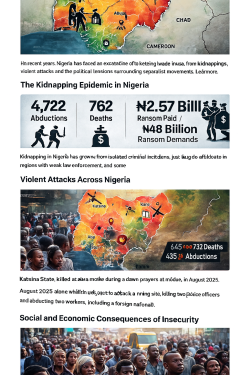
In recent years, kidnapping in Nigeria has escalated into a deeply entrenched problem,  not just a crime, but a business. According to a recent report by SBM Intelligence, between July 2024 and June 2025, 4,722 people were abducted across the country.

The human toll is severe: 762 people are reported to have been killed during this period, even though ransom was paid in many cases.  The total ransom demands during that window reportedly reached ₦48 billion, though only about ₦2.57 billion was actually paid.

This isn’t a random crime wave. Kidnapping in Nigeria has evolved into a “lucrative criminal enterprise,” driven by poverty, weak law enforcement, and economic instability.  Bandit groups, particularly in the North, have entrenched hideouts, as many as 270 “enclaves” of terrorists and bandits were recently reported.

The scale is almost unfathomable: in one recent national crime‑survey period, Nigerians reportedly paid ₦2.2 trillion in ransom.  This is not just about loss of life, it’s an economic hemorrhage, and it feeds back into the insecurity cycle.

Attacks and Violence

Kidnappings are only part of the insecurity picture. Violent attacks by armed groups continue across many parts of the country.

In Katsina State, for example, gunmen attacked a mosque during dawn prayers in August 2025, killing at least 17 worshippers.

In Kwara State, militants reportedly attacked a marble mining site in June, killing two police officers and abducting at least two workers (including a foreign national).

According to a security firm’s report, in August 2025 alone there were 545 “security incidents,” resulting in 732 deaths and 435 abductions.


These figures highlight a grim reality: despite some tactical successes by security forces, insecurity remains deeply rooted and deadly.

Social Consequences

The widespread violence is fracturing trust in institutions. Many Nigerians feel the state is not protecting them.  There are also economic knock-on effects: in states like Benue, insecurity has severely depressed agricultural output.  Your farms, your community,  suddenly are not safe.

There are reports too of mob justice. In one chilling incident in Edo State, a mob killed 16 people who were suspected of being kidnappers, setting tires on fire around them.  Such vigilantism reflects how deeply insecurity has eroded public trust in formal justice systems.


Nnamdi Kanu’s Life Sentence: What It Means

In a major legal and political development, Nnamdi Kanu, leader of the Indigenous People of Biafra (IPOB), was sentenced to life in prison by a Nigerian court.

Here are the key points:

He was convicted on seven terrorism‑related charges, including incitement of violence and “illegal” broadcasts via Radio Biafra.

The judge, James Omotosho, opted not to impose the death penalty, despite the prosecution’s request, citing “mercy” and broader international concerns over capital punishment.

The court found evidence that Kanu’s broadcasts led to attacks, including damage to police stations and other government infrastructure.

The sentence will run concurrently across counts, and Kanu is to be held in protective custody (not in the same prison used for the general inmate population) due to the “tendency for violence” noted by the court.

His radio transmitter was ordered to be forfeited to the federal government.

On the constitutional question: the judge declared that while “self-determination” is a political right, demanding secession “not done according to the constitution” is illegal.

Kanu has 90 days to appeal the verdict.


Reactions have been mixed. Some in the Igbo community and IPOB supporters see the verdict as predetermined and unfair.  Others believe the severity of his sentence reflects how seriously the government views the destabilizing threat of separatist agitation.


Putting It All Together: A Nation at a Crossroads

The kidnapping and insecurity crisis in Nigeria is more than a law‑and‑order issue, it’s a symptom of structural problems:

1. Economic Roots: Poverty, unemployment, and currency devaluation feed into the kidnap business.


2. Weak Institutions: Security forces are overstretched, and policing isn’t evenly effective across regions.


3. Social Fragmentation: Regions feel marginalized (economically and politically), which fuels separatist tensions like the Biafran cause Kanu led.


4. Justice Crisis: Mob violence and lack of trust in law enforcement or formal justice can lead to extrajudicial measures.


5. Political Risk: Sentencing a figure like Kanu carries risk: it could deter separatism through strength, but it could also radicalize or further alienate parts of the population.


Why This Matters

Human Impact: Thousands of Nigerian families live under fear, daily life is disrupted by the threat of abduction or attack.

Economic Drag: The cost of insecurity, both in ransom payments and lost investment,  is massive.

Governance Test: The government’s response to both kidnapping and separatist agitation will shape its legitimacy. Strong but fair justice policies could restore trust; harsh crackdowns risk more division.

International Spotlight: The world is watching,  and condemning,  both the violence and how the state handles dissent.


What Needs to Be Done

1. Strengthen Security Infrastructure: Improve intelligence and rapid response, especially in high-risk zones.


2. Economic Reforms: Address root causes, poverty, unemployment, that make kidnapping so attractive.


3. Dialogue & Inclusion: Engage marginalized groups politically to reduce the appeal of secessionist movements.


4. Rule of Law: Ensure accountability for mob justice, strengthen judicial systems, and provide protection for citizens.


5. International Cooperation: Leverage support from foreign partners to counter cross-border arms flows, train security forces, and stabilize vulnerable regions.


Nigeria stands at a precarious moment. Insecurity through kidnapping and banditry is not just a criminal scourge,  it’s become a business, a political lever, and a social scar. At the same time, the life sentence of Nnamdi Kanu marks a turning point in how the Nigerian state is responding to separatist agitation.

If Nigeria is to navigate this crisis, it will need more than force ,  it needs vision, justice, and inclusion. Without addressing the deeper economic and political drivers, any security gains risk being temporary.

Amid the Storm: The State of Hardship in Nigeria and the Unyielding Spirit of Her People

Nigeria, the giant of Africa, stands today at a crossroads. In every corner of the nation, hardship bites deep. From the bustling streets of Lagos to the farmlands of Benue, from the oil-rich creeks of the Niger Delta to the dusty roads of the North, the reality is painfully evident, times are hard.

The prices of food items have skyrocketed beyond reason. A bag of rice that once fed families comfortably is now almost unreachable for the average earner. Fuel prices climb like a mountain with no peak in sight, while electricity remains unstable, and the cost of transportation rises with every sunrise. For many, survival has become a daily hustle, a matter of grit and grace.

Jobs are scarce. Graduates roam the streets with certificates in hand and hope in heart, yet opportunity remains a distant dream. The Naira weakens against global currencies, and inflation continues to rob families of the dignity of choice. Our healthcare system is stretched, our education system is underfunded, and insecurity continues to test the patience of the people.

But even in these trying times, there is a light that refuses to be dimmed, the Nigerian spirit.

We are people who laugh through pain, who dance in the middle of storms, who hustle not out of choice but out of necessity, and still find time to help a neighbour. We are the ones who turn adversity into jokes, scarcity into invention, and tears into tenacity.

It is okay to be tired. It is okay to cry. But what is not okay is giving up. Nigeria needs you,  your voice, your vision, your resilience.

Remember the stories of those who rose from nothing to something. The market woman who sends four children to school on pure determination. The young tech developer in Enugu building apps with unstable electricity. The mechanic in Kaduna who trains apprentices with hope that they’ll have a better life. The youth corper in a rural village teaching math with chalk and willpower. These are not just stories. These are the heartbeat of a nation that refuses to be broken.

Let us not give up. Let us not hand over our future to hopelessness.

Yes, leadership has failed us time and again. Yes, corruption has crippled systems that should have elevated us. But we are not powerless. Each act of honesty, each moment of kindness, each voice raised for justice,  these are the seeds of the Nigeria we dream of.

We must keep speaking up. Keep building. Keep voting. Keep educating. Keep hoping. Keep praying. And above all, keep believing.

Nigeria is not just her government. Nigeria is you and me. And if we must rebuild this nation brick by brick, voice by voice, heart by heart, then so be it.

To every Nigerian facing hardship today , you are not alone. Your struggle is real, and your strength is valid. Keep going. One day, the sun will rise on a better Nigeria, and it will rise because you refused to give up.


#NigeriaWillRiseAgain
#NaijaStrong
#NeverGiveUp
#HopeInTheStorm

The Silent Killer: Unmasking the Dangers of Undiagnosed Sleep Apnea in Afric

Introduction

In many African communities, loud snoring is often joked about or dismissed as harmless. But what if that snoring was actually a warning sign of a serious health condition? Sleep apnea — a condition where breathing repeatedly stops and starts during sleep — is a growing but largely ignored health threat across the continent. Left undiagnosed and untreated, it can lead to deadly complications.

This blog post explores the dangers of undiagnosed sleep apnea in Africa, the cultural and systemic challenges surrounding its diagnosis, and why awareness and early intervention are crucial.


What Is Sleep Apnea?

Sleep apnea is a sleep disorder where breathing repeatedly stops and starts, often due to obstruction of the airway (obstructive sleep apnea) or issues with brain signaling (central sleep apnea). The most common form, obstructive sleep apnea (OSA), is frequently linked to obesity, age, and anatomical factors like enlarged tonsils or narrow airways.

Signs of sleep apnea include:

  • Loud, chronic snoring
  • Gasping or choking during sleep
  • Daytime fatigue
  • Morning headaches
  • Poor concentration
  • Mood changes

Despite being common, sleep apnea often goes undiagnosed — especially in African settings.


The African Challenge: Why So Many Cases Go Undiagnosed

  1. Low Awareness
    Most people in Africa, including healthcare providers, are not familiar with sleep apnea or its symptoms. Snoring is often seen as a minor issue or even a humorous trait, rather than a red flag for a serious health risk.
  2. Limited Access to Diagnosis
    Sleep studies, which are necessary to diagnose sleep apnea, require specialized equipment and trained personnel. These are mostly unavailable in rural areas and even rare in urban centers across many African countries.
  3. Misdiagnosis
    Fatigue, memory problems, or high blood pressure caused by sleep apnea are often misdiagnosed as stress, anemia, or lifestyle-related issues. The root cause — disordered breathing during sleep — remains hidden.
  4. Stigma and Cultural Beliefs
    Some people associate nighttime choking or fatigue with spiritual attacks, witchcraft, or curses. This can delay proper medical evaluation and treatment.

The Health Risks of Ignoring Sleep Apnea

When left untreated, sleep apnea can lead to serious, sometimes life-threatening complications:

  • Cardiovascular Disease: Repeated drops in oxygen levels strain the heart, increasing the risk of high blood pressure, heart attacks, and strokes.
  • Type 2 Diabetes: Sleep apnea can worsen insulin resistance, making it harder to control blood sugar levels.
  • Cognitive Decline: Sleep apnea interferes with brain function, leading to memory loss, poor focus, and increased risk of dementia.
  • Mental Health Issues: Depression and anxiety are common in people with untreated sleep apnea.
  • Accidents: Excessive daytime sleepiness increases the risk of road and workplace accidents.

The Way Forward: Raising Awareness and Saving Lives

  1. Community Education
    Grassroots campaigns are needed to educate people about sleep apnea, its symptoms, and the serious health consequences of ignoring it.
  2. Training Healthcare Workers
    Primary healthcare providers should be trained to recognize sleep apnea symptoms and refer patients for further evaluation.
  3. Affordable Screening Tools
    Innovations like portable home sleep testing devices or simple screening questionnaires (like the STOP-BANG) can help identify high-risk individuals.
  4. Policy and Support
    Governments and NGOs need to integrate sleep health into public health strategies and allocate funding for diagnosis and treatment.
  5. Lifestyle Interventions
    Educating communities about weight management, smoking cessation, and alcohol moderation can also reduce sleep apnea risk.

Conclusion: It’s Time to Wake Up to the Dangers of Sleep Apnea

Sleep apnea is not just a “rich man’s disease” or a Western problem. It is a silent killer affecting millions of Africans — most of whom remain undiagnosed. The cost of inaction is too high. It’s time to demystify this condition, break the silence, and prioritize sleep health as part of the broader African public health agenda.

If you or someone you know snores heavily, wakes up tired, or struggles to stay awake during the day — don’t ignore it. Talk to a healthcare provider. Sleep well, live well.


Tags: #SleepApneaAfrica #SilentKiller #AfricanHealth #SnoringAwareness #SleepDisorders #PublicHealthAfrica #ObstructiveSleepApnea #HealthEducation #UndiagnosedConditions

Introduction: A New Kind of Worship Where the Body is Sacred, and Health is Holy

Welcome to the Church of Wisdom

Introduction: A New Kind of Worship

In the Church of Wisdom, we don’t preach God. We don’t quote religious doctrine. Instead, we preach something more immediate, more intimate, our bodies. This is not a church of theology, but of biology. Not a place of superstition, but of self-awareness.

We gather not around altars, but around health, knowledge, and gratitude. We raise our hands not in surrender, but in celebration, of lungs that breathe, hearts that beat, and organs that never sleep.

The Body Is the Real Temple

The ancient scriptures already hinted at it:
“Your body is a temple.” (1 Corinthians 6:19)

But in the Church of Wisdom, we don’t stop at metaphor. We live it. We believe the body is sacred, and it deserves our respect, attention, and care.

You don’t need to look to the heavens for miracles, you are one.

You don’t need to fear sin, just learn what’s hurting your temple.

You don’t need to be born again, just reconnect with yourself.

Praise Be to the Organs

Let us worship the internal choir that keeps us alive:

❤️ The Heart

Beating over 100,000 times a day, without vacation, without complaint. The eternal drummer of life.

 The Lungs

Our twin wings, exchanging oxygen for carbon dioxide in quiet grace. Every breath is a prayer.

易 The Brain

The electric cathedral where thought, emotion, and identity reside. Your consciousness lives here.

溺 The Gut

Your second brain. It digests, communicates, regulates. A holy network of trillions of cells and microbes.

 The Kidneys

Our humble filters, quietly cleansing the blood, hour after hour. A true example of service.

 The Liver

The master alchemist. Processing every toxin, every nutrient, every indulgence.

留‍♂️ The Skin

Our boundary and our interface, a living robe, shielding and sensing the world around us.

Let us give thanks. Let us not wait until they fail to acknowledge their work.

Our Rituals of Reverence

Every spiritual tradition has its rituals. In the Church of Wisdom, our practices are rooted in care and consistency, not dogma.

復 Sacred Nourishment
Whole foods. Water. Fiber. Colorful plates. Eating as communion with life.

律 Movement Prayer
Yoga, walking, stretching, lifting, all forms of moving meditation.

 Rest as Worship
Deep sleep, regular sleep, uninterrupted sleep. A sacred reset every night.

律‍♀️ Meditation as Scripture
Breathe. Be still. Listen to your body. It is always preaching, in signals, not words.

 Gratitude Practice
Before meals, after workouts, during quiet moments:
“Thank you, liver. Thank you, heart. Thank you, body.”

Sin and Redemption, Reimagined

In this church, sin is self-neglect.

Chronic stress

Junk food

Excess alcohol

Sedentary lifestyle

Ignoring pain and signals from within

But there is no eternal punishment, only consequences. And there is always redemption through change:

A glass of water

A short walk

A moment of silence

A return to balance

Forgiveness is cellular. Recovery is real. Your body wants to heal. Let it.

Community Over Judgment

There are no saints here, only seekers.
No sinners, only those who forgot to listen.

In the Church of Wisdom, we are all students of our biology, mental health, and emotional balance. We support one another, through illness, weight loss, healing, and growth.

We don’t judge others for the condition of their temple.
We offer tools. We share knowledge.
We practice compassion, not comparison.

Closing Benediction

You are the miracle.
Your body is the temple.
Keep it holy.

Raise your hands if your heart is beating — HALLELUJAH!
Take a deep breath if your lungs are working — HALLELUJAH!
Blink your eyes, wiggle your fingers — PRAISE BE TO THE BODY!

Let every workout be a sermon.
Let every meal be communion.
Let every night’s rest be resurrection.

Welcome, dear seeker, to the Church of Wisdom.

Amen to the Mind.
Amen to the Body.
Amen to the Temple Within.

Heart, lungs, brain, kidneys, labelled with affirming captions like “Thank you,” “Sacred,” or “Keep me holy.”


Adapting Content for Diverse Audiences: A Strategic Approach to Promoting a Fitness App

In today’s digital landscape, the success of any marketing campaign hinges on the ability to communicate effectively with diverse audiences. One-size-fits-all content is no longer sufficient. Instead, marketers must tailor their messages to align with the unique characteristics, values, and preferences of different demographic segments. This is particularly relevant when promoting a product like a fitness app that targets both individuals aged 18–34 and adults aged 55 and older. These two groups differ significantly in their lifestyle, technological familiarity, and motivations for using a fitness app. As content writers, it is our responsibility to bridge this generational gap by adapting our writing style, tone, language, and messaging strategy to meet the distinct needs of each audience.
Understanding the Audience: Generational Differences
Young adults aged 18–34 are digital natives who seek convenience, instant gratification, and integration with social media. They are generally tech-savvy, prefer conversational language, and are motivated by goals such as aesthetics, performance, and community engagement. In contrast, individuals aged 55+ may value health maintenance, mobility, and longevity over appearance. While many in this age group are comfortable with technology, they tend to be more cautious and appreciate clear instructions, trustworthiness, and functionality over flashy features (Smith, 2022).
Tailoring Content: Strategies and Examples
When writing for the 18–34 demographic, a casual, energetic tone that emphasizes lifestyle benefits and community interaction is most effective. For example:
“Ready to smash your fitness goals and show off your progress? Our app syncs seamlessly with your smartwatch, lets you compete with friends, and gives you daily motivation straight from your favourite influencers!”
In contrast, content for the 55+ audience should be more informative, empathetic, and focused on ease of use and health benefits. For example:
“Stay active, healthy, and independent with our easy-to-use fitness app designed for your lifestyle. Track your steps, monitor your heart rate, and get gentle reminders to keep moving, all from a trusted, user-friendly platform.”
This shift in tone and vocabulary reflects an understanding of what matters most to each group. While the younger demographic appreciates trendiness and tech integration, the older group values simplicity, safety, and reliability.
Addressing Challenges: Bridging the Generational Gap
Adapting content for such diverse audiences comes with challenges, particularly regarding technological literacy and generational values. A message that resonates with a 25-year-old might confuse or alienate a 65-year-old. The use of slang, abbreviations, or fast-paced storytelling may not be effective across the board.
To overcome this, segmenting content is key. Creating different landing pages, email newsletters, or social media ads tailored to each demographic allows for personalization without compromising message clarity. Additionally, using inclusive design principles, such as readable fonts, voice-enabled navigation, and step-by-step tutorials, helps ensure that older adults can engage with the app confidently.
Another strategy is incorporating testimonials and case studies from real users within each age group. A video of a 30-year-old achieving a personal best through the app can inspire peers, while a testimonial from a 60-year-old discussing improved mobility or better sleep builds trust among older users.
The Power of Understanding Audience Preferences
Effective communication begins with empathy and research. Understanding your audience’s habits, aspirations, and pain points allows you to craft content that is not only informative but also emotionally resonant. A study by the Content Marketing Institute (2023) found that audience segmentation and targeted messaging increased engagement rates by over 60%. This highlights the critical role of adapting language and tone to meet diverse audience needs.
Conclusion
In a world where personalization is paramount, adapting your writing to cater to multiple audiences is more than just a best practice, it’s ’s a necessity. When promoting a fitness app to both younger and older adults, understanding the core differences in communication styles, values, and technological comfort is essential. By crafting ageappropriate content, using tailored messaging strategies, and overcoming generational gaps with empathy and clarity, content writers can drive engagement, foster trust, and ultimately, help more users lead healthier lives. Knowing your audience isn’t just about demographics. It’s about delivering the right message in the right way at the right time.

References
Content Marketing Institute. (2023). 2023 B2C content marketing benchmarks, budgets, and trends. https://contentmarketinginstitute.com
Smith, A. (2022). Generational tech use and digital literacy in the United States. Pew Research Centre. https://pewresearch.org

Confronting Racism in the Workplace: How to Deal with It and Rise Above


Racism in the workplace remains one of the most painful and persistent barriers to inclusion, productivity, and equality. Whether subtle or overt, it can leave long-lasting psychological scars and hinder professional growth for those affected. From discriminatory hiring practices and biased evaluations to exclusion from opportunities or being the subject of microaggressions, racism shows up in many forms.

Recognizing Racism at Work

Before tackling the problem, it’s important to recognize it. Racism at work might look like:

Being overlooked for promotions or assignments despite qualifications.

Unequal treatment in disciplinary actions or workload distribution.

Stereotyping or jokes based on race or ethnicity.

Tokenism, where you’re included only to tick a diversity box.

Microaggressions, subtle behaviors or comments that imply bias (e.g., “You’re very articulate for someone from [your country]”).


Such experiences can lead to anxiety, burnout, self-doubt, and even health issues if not addressed.

How to Deal with Racism in the Workplace

1. Document Everything
Keep a detailed record of incidents. Include dates, times, what was said or done, and any witnesses. This is important if you need to report the behaviour formally.


2. Address It Directly (If Safe)
If you feel safe, speak to the person involved. Sometimes, people are unaware that their comments or behavior are offensive. A calm, respectful conversation can sometimes change behaviour.


3. Report It to HR or Management
Most companies have anti-discrimination policies in place. Use the appropriate channels to report the issue. Your documentation will help back up your claims.


4. Seek Allies
Connect with colleagues who value fairness. A strong support system can help you navigate challenges and feel less isolated. You may also find allies who are willing to speak up on your behalf.


5. Know Your Rights
Familiarize yourself with your country’s workplace discrimination laws. In many countries, including the U.S., U.K., Canada, Germany, and South Africa, you are legally protected against workplace racism.


6. Take Care of Your Mental Health
Experiencing racism is emotionally draining. Talk to a therapist, counselor, or join support groups where you can share and heal.


7. Consider External Support
If your company fails to act, consult an employment lawyer or reach out to civil rights organizations. Legal and public pressure often forces accountability.


Rising Above: Turning Pain into Power

Dealing with racism is deeply challenging, but many have used the experience to become stronger, more vocal advocates for change. You can:

Mentor others who face similar challenges, providing guidance and strength.

Speak up about diversity and inclusion in meetings or company forums.

Advocate for policy changes that make your workplace fairer for everyone.

Celebrate your identity — don’t let racism diminish your self-worth or confidence.


Final Thoughts

Racism at work isn’t just a “personal problem” — it’s a structural failure that hurts individuals, teams, and organizations. Companies that are truly inclusive empower all employees to thrive, regardless of race or background. By standing firm, speaking out, and supporting one another, we can challenge toxic systems and build work environments that are fair, respectful, and empowering for all.

Remember: You belong. You deserve respect. And you’re not alone.

The Best Way to Learn About Health: Through Experience


When it comes to understanding health and the intricate workings of the human body, no textbook, documentary, or lecture can match the insight that comes from lived experience. You can read about the symptoms of fatigue, heart palpitations, or indigestion—but it’s only when your own body starts sending out signals that you truly begin to grasp what those words mean.

Learning the Hard Way: When the Body Speaks, Listen

For many people, the journey into real health education begins with a crisis: a diagnosis, a sudden illness, or a persistent symptom that refuses to go away. It’s often at that point—when doctors are puzzled, medications don’t seem to work, and tests come back inconclusive—that we’re forced to become our own researchers, advocates, and healers.

We begin to notice patterns. Maybe certain foods leave us bloated and tired. Maybe late nights and stress wreak havoc on our blood pressure. We start to listen more intently to the subtle whispers of our bodies before they become screams.

From Observation to Understanding

Experience teaches you to move beyond generic advice and discover what truly works for your unique physiology. One person’s superfood might be another’s trigger. Some thrive on early morning workouts, while others find strength later in the day. No two bodies are alike, and no single health philosophy fits all.

Tracking your body’s responses over time, testing lifestyle changes, and staying curious allows you to gather personal data that becomes more valuable than any doctor’s brief consultation. You learn the language of your body: how it reacts to stress, what kind of sleep it needs, how hydration affects your energy levels, or how gut health influences your mood.

Bridging Science and Personal Wisdom

This isn’t to say science isn’t important—on the contrary. Understanding anatomy, physiology, and nutrition can enhance your experience-based learning. But science becomes most powerful when it’s applied practically to your day-to-day life. When you’ve felt what a magnesium deficiency does to your nerves or how blood sugar spikes influence your mental clarity, those scientific facts become real, memorable, and life-changing.

The Path Forward

Learning through experience doesn’t mean ignoring professionals—it means becoming an active participant in your own health journey. Ask questions. Keep records. Experiment wisely. Share your story. Most importantly, treat every symptom or struggle as an invitation to go deeper into understanding your body.

In a world full of noise and quick fixes, experience remains the most honest, direct, and effective teacher when it comes to health.

Your body is the classroom. Life is the curriculum. And experience is the most trusted textbook you’ll ever read.


How to Deal with and Overcome Toxic Situations

Life is full of ups and downs, and sometimes we find ourselves in situations that drain our energy, shake our confidence, or threaten our peace of mind. Toxic situations—whether at work, in relationships, or within our own minds—can take a toll on our mental, emotional, and even physical well-being. But the good news is that you don’t have to stay stuck in toxicity. You can rise above it and create a healthier, more fulfilling life.

Recognizing a Toxic Situation

Before you can deal with toxicity, you must first recognize it. A toxic situation often includes:

Negative energy and constant stress – You feel emotionally drained whenever you engage in it.

Manipulation and control – Someone is always trying to control your choices, emotions, or time.

Lack of respect – Your boundaries, thoughts, and feelings are ignored or belittled.

Frequent conflict and drama – Instead of peace, there’s constant tension or unnecessary fights.


If any of these sound familiar, you may be dealing with a toxic environment or relationship.

Steps to Deal with Toxic Situations

1. Set Clear Boundaries

Toxic people and environments thrive on the ability to invade your personal space—physically, emotionally, or mentally. Setting firm boundaries is essential.

Say “no” without guilt.

Limit interactions with toxic individuals.

Define what is acceptable behavior and enforce it.


2. Stay Calm and Don’t Engage in Drama

Toxic situations often feed on emotional reactions. The more you react, the more fuel you give to the negativity. Instead of engaging:

Stay composed and respond rationally.

Avoid unnecessary arguments or confrontations.

If necessary, walk away instead of engaging in toxic exchanges.


3. Protect Your Energy

Just as you wouldn’t willingly drink poison, you should avoid absorbing toxic energy.

Limit exposure to negative conversations, news, or social media.

Practice self-care through meditation, exercise, and healthy eating.

Surround yourself with positivity—uplifting people, music, and books.


4. Focus on Solutions, Not Problems

When dealing with a toxic situation, it’s easy to get stuck in complaining. Instead of dwelling on the problem, ask yourself:

Can I change this situation? If yes, take action.

Is this situation out of my control? If so, let go and move forward.

What lessons can I learn? Use the experience to grow stronger.


5. Seek Support

You don’t have to face toxic situations alone. Talk to a trusted friend, mentor, or therapist for guidance. Their outside perspective can help you navigate the situation with more clarity and strength.

6. Take Action and, If Necessary, Walk Away

Some toxic situations can be fixed with boundaries and communication. Others require a more drastic step—walking away.

If a job is draining you and affecting your mental health, it may be time to look for another.

If a relationship is filled with emotional or physical abuse, leaving may be the healthiest option.

If a habit is toxic (e.g., substance abuse, negative self-talk), seek professional help and start fresh.


Overcoming and Moving Forward

Dealing with toxicity is not just about escaping it—it’s about healing and growing from the experience. After removing yourself from a toxic situation:

Forgive, but don’t forget – Let go of resentment, but learn from the experience.

Rediscover yourself – Engage in activities and relationships that bring joy.

Stay vigilant – Be mindful of red flags in the future to avoid repeating toxic cycles.


Final Thoughts

Toxic situations are part of life, but they don’t have to define you. By setting boundaries, staying calm, protecting your energy, and making empowered choices, you can overcome them and thrive. Remember, your peace is priceless—never be afraid to protect it.

What toxic situation are you currently dealing with, and how are you handling it? Let’s discuss in the comments.

When Wives Choose Porn Over Intimacy: A Growing Relationship Dilemma

When Wives Choose Porn Over Intimacy: A Growing Relationship Dilemma

In many relationships, intimacy plays a crucial role in maintaining emotional and physical connection. However, a growing concern in modern marriages is the issue of spouses who become addicted to pornography, leading to a decline in real-life intimacy. This is especially problematic when a wife refuses to engage in intimacy with her husband but still expects him to remain faithful despite his unfulfilled needs.

The Rise of Porn Addiction in Relationships

Pornography has become more accessible than ever, thanks to the internet and smartphones. While some couples watch it together or use it to enhance their intimacy, others find it becomes a replacement for real-life connection. For some wives, porn offers an escape from stress, a way to explore fantasies, or even an outlet for personal struggles like anxiety or self-esteem issues.

But when it turns into an addiction—where watching porn takes priority over real-life intimacy—it can damage a marriage. A wife who constantly indulges in pornography while rejecting physical closeness with her husband is creating an emotional and physical gap in the relationship.

The Double Standard: No Sex, But No Cheating

One of the biggest frustrations in such situations is the expectation that the husband should remain loyal, even though his physical and emotional needs are being ignored. This creates a contradiction:

1. She refuses intimacy. Whether due to disinterest, emotional disconnect, or the preference for self-satisfaction, she is unavailable to her husband.


2. She remains sexually stimulated—but only through porn. This means the issue is not a complete lack of libido but rather a shift in what arouses her.


3. She expects absolute fidelity. Even though she is not fulfilling her husband’s needs, she still demands that he remains faithful and does not seek satisfaction elsewhere.

This situation leads to resentment, frustration, and sometimes even infidelity—not because the man is inherently unfaithful, but because he is being denied a fundamental part of marriage.

The Psychological and Emotional Toll

A husband in this situation may experience:

Rejection and loneliness. Feeling unwanted by one’s spouse is emotionally painful.

Frustration and temptation. The lack of intimacy can push a man towards pornography himself, emotional affairs, or even physical cheating.

Resentment. Over time, bottled-up frustration can turn into bitterness, affecting communication and overall harmony in the relationship.

Possible Solutions

If a marriage is struggling with this issue, ignoring it won’t make it go away. Both partners need to address the problem together:

1. Open Communication. The husband should express his feelings honestly, without accusations, and try to understand his wife’s perspective.


2. Professional Help. Porn addiction is real, and therapy or counseling might be necessary to break unhealthy habits.


3. Rebuilding Intimacy. The couple can explore new ways to reconnect emotionally and physically, including date nights, deep conversations, and seeking professional guidance if needed.


4. Compromise and Mutual Understanding. If one partner’s needs are not being met, both must work towards a solution that respects each other’s desires.

Final Thoughts

Marriage is about partnership, compromise, and fulfilling each other’s needs—emotionally, physically, and mentally. If a wife is addicted to pornography and refuses intimacy with her husband while demanding complete fidelity, it creates an unfair imbalance that can destroy the relationship.

A healthy marriage requires mutual effort. If one person withdraws, the other will naturally feel abandoned. The key is open dialogue, understanding, and a willingness to fix the problem before it leads to irreparable damage.

Am Darkydey.

Make Every Day the Best Day of Your Life

In a world that constantly pulls us in different directions, finding joy and meaning in daily life can sometimes feel elusive. Yet, what if the secret to a fulfilling life lies in embracing the present and choosing to make every single day the best day of your life?

Here are some practical ways to transform ordinary days into extraordinary ones:

1. Start with Gratitude

The simplest way to shift your mindset is through gratitude. Each morning, take a moment to reflect on three things you’re thankful for. It could be as significant as the love of family or as simple as the sound of birds outside your window. Gratitude tunes your mind to appreciate what you already have and sets a positive tone for the day.

2. Embrace the Power of Intention

Instead of just going through the motions, start your day with a clear intention. Ask yourself: What would make today amazing? Whether it’s completing a task, calling a loved one, or enjoying a moment of solitude, setting an intention gives your day purpose.

3. Find Joy in the Little Things

Happiness is not always found in grand achievements; it thrives in the small, seemingly mundane moments. Savour your morning healthy tea, enjoy the warmth of the sun on your face, or take delight in a kind smile from a stranger. Training yourself to notice life’s simple pleasures can transform any day into a great one.

4. Prioritize Your Well-Being

A happy mind lives in a healthy body. Make exercise, nourishing food, and adequate sleep non-negotiable parts of your routine. Even a brisk walk outdoors or a short meditation session can help you feel rejuvenated and ready to face the day.

5. Create Moments of Connection

Humans are wired for connection. Whether it’s a heartfelt conversation, a shared laugh, or simply spending quality time with a loved one, these moments remind us of what truly matters. Strengthening relationships can make even the toughest days brighter.

6. Be Fully Present

With the constant noise of emails, notifications, and deadlines, staying present can be a challenge. Yet, it is one of the most powerful ways to enrich your life. Try to focus fully on what you’re doing, whether it’s working, eating, or spending time with others. Being in the moment deepens your experiences and helps you make the most of every day.

7. Learn Something New

Every day is an opportunity to grow. Whether it’s reading a new book, learning a skill, or listening to a podcast, investing in self-improvement brings excitement and fulfilment into your daily life.

8. Give Back

Acts of kindness not only improve someone else’s day but also elevate yours. Volunteering, helping a coworker, or even a simple compliment can bring a sense of purpose and happiness that lingers long after the act itself.

9. Embrace Life’s Imperfections

Not every day will be perfect, but that’s what makes life beautiful. Accept challenges as opportunities to grow. Let go of things beyond your control and focus on how you can respond positively.

10. Reflect on Your Day

Before going to bed, take a moment to reflect. What went well? What could have been better? Acknowledge your victories, no matter how small, and end the day on a note of self-compassion and optimism.

Life isn’t a future destination; it’s what’s happening right now. By choosing to embrace each moment and seeking joy in the ordinary, you can turn every day into the best day of your life. It’s not about having perfect days—it’s about making the most of the days you have.

So, take a deep breath, smile, and ask yourself: How can I make today amazing? Your answer might just surprise you.

Am Darkydey…